

Commercial Kitchen Equipment Maintenance Before the Holiday Rush: A Spokane Checklist
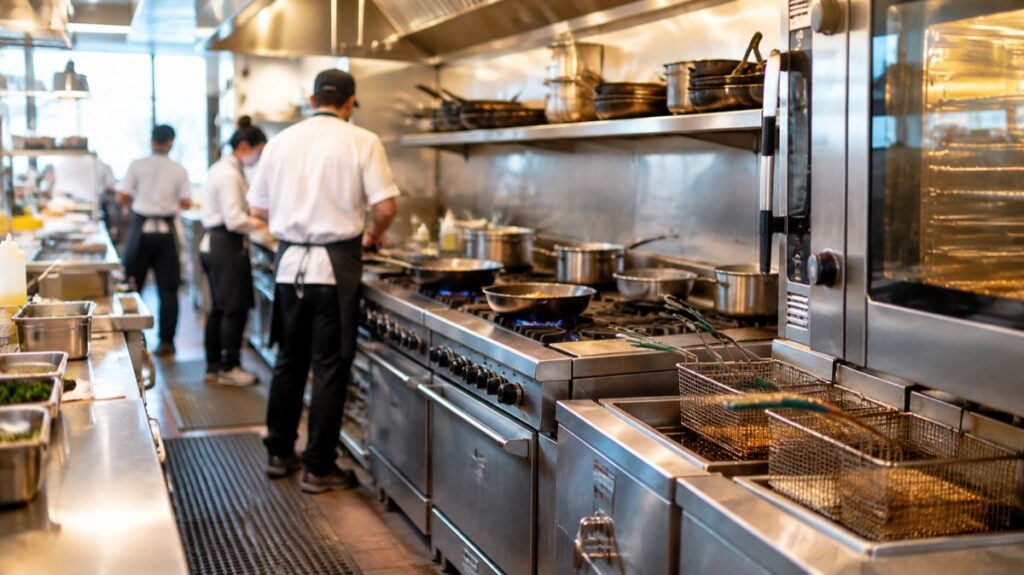
The convection oven that quits on the Wednesday before Thanksgiving was not fine on Tuesday. It had been marginal for weeks, and a slow night never asked enough of it to show. That is the case for commercial kitchen equipment maintenance in the middle of November. The holiday rush does not break equipment. It finds the parts that were already on their way out, and it finds them with a full dining room watching.
Table of Contents
Why the Holiday Rush Finds Every Weak Part
A slow Tuesday lets an oven coast. The door opens, heat spills out, the burner fires, and the oven has ten quiet minutes to climb back to temperature. During a holiday service the door opens every few minutes, so the burner has to light quickly and run hard, over and over. Technicians call that recovery. An igniter that takes three tries to light is invisible on a slow night. On a banquet night it is the reason the oven never catches up.
The calendar is the second problem. Parts suppliers close on Thanksgiving Day and most run short crews that Friday. A fryer high-limit that arrives the next morning in October can take until Monday in Thanksgiving week. Four days is a long time to run a holiday menu on one fryer. So commercial kitchen equipment maintenance belongs in the second or third week of November, not the fourth.
A Commercial Kitchen Equipment Maintenance Checklist for the Hot Line
Ovens and ranges
Put an oven thermometer in the center of the cavity, set the dial to 350, and let it cycle for 20 minutes. If the two disagree by more than 25 degrees, the thermostat needs calibrating. Cooks adapt to a slow oven without telling anyone. They add six minutes and move on. That falls apart when a holiday crew is cooking from a prep sheet that assumes 350 means 350.
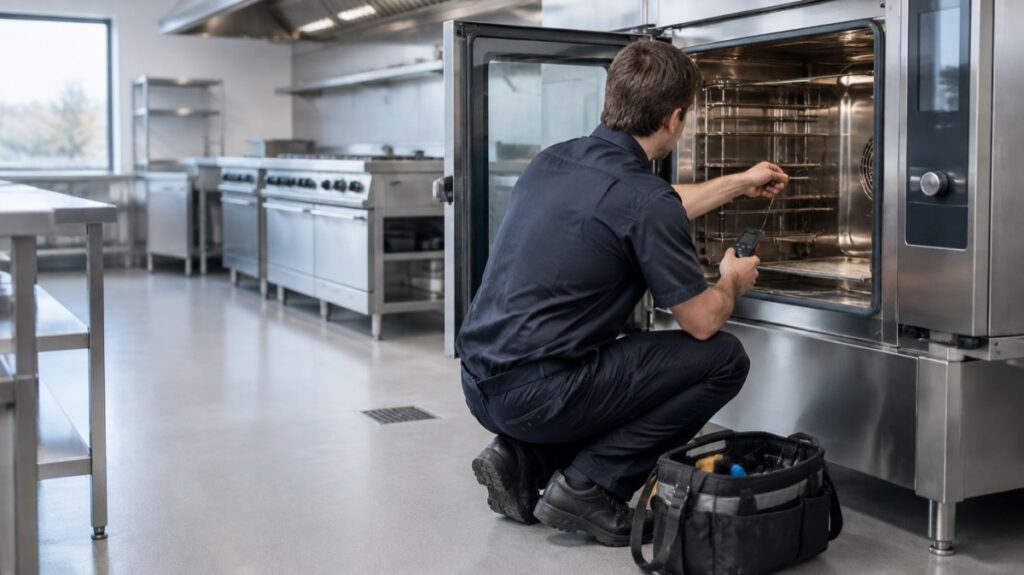
Then look at the burner flames. They should be blue and steady. Yellow, lazy flames mean dirty burners or a gas pressure problem. On convection ovens, check the door gasket, because a door that does not seal leaks heat every minute it is shut.
Fryers
Time them. Drop a full basket of frozen fries and count how long the oil takes to return to its setpoint, then write the number on the fryer. If two matching fryers post different times, the slow one has a fault, usually sooted burner tubes or a thermostat probe caked in carbon.
Have the high-limit tested. It is the safety that shuts the burner down if the thermostat sticks, and it is the only thing standing between an overheated vat and a fire.
Steam tables and holding cabinets
Hot food has to hold at 135 degrees or above under the FDA Food Code. A holding cabinet with a failing element can read 150 on its dial while the product inside sits at 120. Probe the food, not the cabinet.
The dish machine
When the dish machine goes down, a 200-cover night stops, because the kitchen runs out of plates before it runs out of food.
Most high-temperature machines sanitize with a 180 degree final rinse, and that heat comes from a booster heater. Spokane and Coeur d’Alene both pump their water from the Spokane Valley-Rathdrum Prairie Aquifer, and it is hard water. Scale coats the booster’s heating elements the way it coats a kettle, and a scaled element heats slowly and then burns out. Watch the final rinse gauge through a full rack. If the needle sags below 180, delime the machine and have the booster looked at.
The Winter Problem That Starts in the Hood
The pilots on the range start blowing out. The back door whistles, and the front door takes a real pull to open. Nothing on the line has changed.
What changed is the weather. The exhaust hood over a busy line pulls thousands of cubic feet of air out of the building every minute, and that air has to be replaced. Replacing it is the job of the makeup air unit on the roof. In July nobody thinks about it. In late November the unit has to heat 25 degree air before it lands on the cooks. If its burner fails to light, it blows cold air onto the line until someone switches it off, or it locks itself out.
With nothing feeding the hood, the kitchen takes air from wherever it can: under the doors, through the dining room, and down the flue of the water heater. That draft drags pilot flames sideways, and it can pull combustion gases back into the building. The range is fine. The building is short of air. It helps to have one company that works on both the cooking line and the rooftop equipment, because this fault lives between the two.
What We Do Not Recommend
Do not schedule the deep clean for the night before your biggest day. Degreaser and a pressure sprayer push water into igniters, pilot assemblies, and control boxes. Clean a week ahead, so anything that got wet has time to show itself.
Do not replace a working piece of equipment the week before Thanksgiving. A new fryer needs its gas pressure set, its thermostat verified, and a crew that knows its habits. If the old one is limping, repair it, get through the season, and replace it in January when a bad day costs less.
Do not let anyone bypass a safety to finish a shift. If a fryer only runs with its high-limit jumpered, that fryer is down. Treat it that way.
The Cold Side Carries the Same Load
Holiday prep fills the walk-in to the walls, and a packed box is harder to cool. We cover that in walk-in freezer maintenance before winter. For how the two sides of a kitchen differ, see our guide to hot-side and cold-side kitchen equipment.
What Staff Can Check and What Needs a Technician
Your crew can handle the daily side of commercial kitchen equipment maintenance: thermometer checks, fryer timing, the rinse gauge, washing hood grease filters, and making sure gas hoses and restraining cables are reconnected after equipment is rolled out for cleaning. Gas pressure, thermostat calibration, burners, safeties, booster heaters, and the makeup air unit belong to a technician.
Our NATE certified technicians work in kitchens across Spokane, Spokane Valley, Liberty Lake, Coeur d’Alene, Post Falls, and Hayden. Our commercial kitchen repair service covers the cooking line, warewashing, and ventilation, and our commercial maintenance programs put the fall visit on the calendar. Request service at least ten days ahead of your first big date, so a part has time to arrive.
Frequently Asked Questions
How often should commercial kitchen equipment maintenance be done?
Twice a year suits most kitchens: once in fall before the holidays and once in spring before patio season. Fryers and dish machines in high-volume kitchens are worth a look every quarter.
What should a restaurant check before the holiday rush?
Oven temperature against a separate thermometer, fryer recovery time, holding temperatures, the dish machine’s final rinse, and the makeup air unit.
Why do my pilot lights keep going out in winter?
Usually the kitchen is short of air. If the makeup air unit is off or locked out, the exhaust hood pulls air in through doors and flues, and that draft blows pilots out.
Can my staff do commercial kitchen equipment maintenance themselves?
Part of it. Staff can check temperatures, time fryers, and wash hood filters. Gas, calibration, safeties, and makeup air need a technician.
What temperature should a commercial dishwasher’s final rinse reach?
180 degrees on most high-temperature machines. Low-temperature machines sanitize with chemicals, so check the sanitizer strength with test strips.