


Walk-In Freezer Maintenance Before Winter: What Spokane Kitchens Should Check Now
Most operators think of winter as the easy season for refrigeration. It is 20 degrees outside, the freezer wants to sit at 0, so the compressor ought to coast. Then December arrives, and we still get the calls. Walk-in freezer maintenance in October costs far less than any of those calls, and the faults it catches aren’t the ones people expect. A walk-in does not fail in a cold snap because it is cold. It fails because cold air changes how the condensing unit behaves, and parts that were fine in August quietly stop being fine.
Table of Contents
Why a Cold Spokane Winter Is Hard on a Freezer
Outdoor air does not cool the box. Refrigerant does. It picks up heat inside the walk-in, carries it through a sealed loop to the condensing unit, and the condenser dumps that heat outside. In July, dumping heat is the hard part. In January it is too easy.
When the air around the condenser drops to 10 degrees, the refrigerant inside it cools so much that its pressure collapses. That pressure is called head pressure, and the expansion valve at the evaporator needs at least some of it to meter refrigerant into the coil. Too little and the coil is starved. The box warms, the coil frosts unevenly, and the compressor runs long hours chasing a temperature it cannot reach. It looks like a dying compressor. Often the compressor is fine.
Air-cooled units in cold climates are built to prevent this with fan-cycling controls or a flooding valve, plus a crankcase heater that keeps oil from soaking up refrigerant while the unit sits idle. None of it is exotic. It is simply the one season those parts are truly tested, and a fan cycling switch that failed in June will not announce itself until the first hard freeze.
Walk-In Freezer Maintenance Checklist for October
Spokane and Coeur d’Alene usually see the first real cold in November, with single-digit nights not unusual by mid-December. October is the last easy month to be on a roof or a back pad with a gauge set.
Door gaskets and heater wire
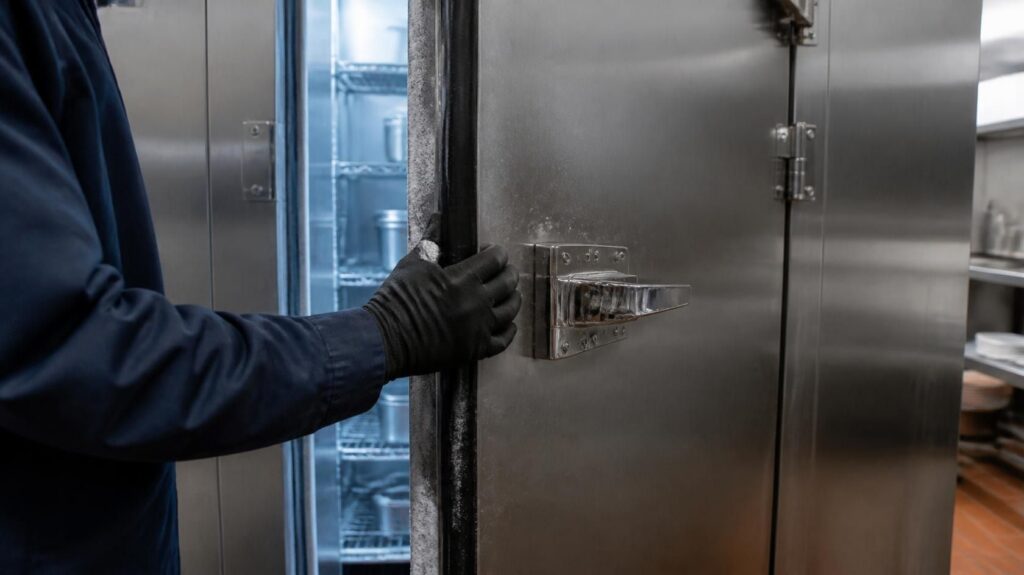
Close the door on a dollar bill. If it slides out without resistance, that gasket is leaking. In summer, a leaky gasket wastes energy. In winter it pulls warm, wet kitchen air into a box that is 0 degrees, and that moisture turns to frost on the evaporator and the floor around the door. The frame also carries a heater wire that keeps the door from freezing shut. When it fails you find out with a cart of product on the wrong side of the door.
Evaporator coil, defrost heaters, and drain lines
A freezer evaporator builds frost by design and clears it on a timed defrost cycle. Check that the defrost heaters actually come on, that the termination switch ends the cycle, and that the drain pan and drain line heaters work. The drain line is the usual culprit. It leaves the heated box, runs through a cold wall or floor, and freezes solid. Water backs up, then ice forms inside the unit, and the next defrost cycle makes it worse.
Condensing unit, outdoors
October means leaves and pine needles pack into the condenser coil, restricting airflow just as much as summer dust does. Clean it, then check fan blades and motors, the contactor, the capacitor, and the head pressure controls described above. In snow country, the other job is clearance. Drifted snow or a plowed pile against a condenser starves it of air from the other direction, so leave at least two feet around the unit and clear it after every storm.
A real temperature log
Record the box temperature at the same time each day for two weeks. If the thermostat says 0 but a calibrated thermometer reads 6, you have a problem now, and it will not shrink in December when you load the box for the holidays.
What We Do Not Recommend
Do not answer a warm freezer by turning the setpoint down. A box that cannot hold 0 will not hold minus 10. It will run longer while the real fault stays exactly where it was, and you will pay for the extra hours on your electric bill.
Do not replace a condensing unit before someone has measured head pressure and checked the expansion valve. A unit that looks tired, with a dead fan cycling switch or a stuck valve, can be a repair in the hundreds of dollars rather than a replacement in the thousands. If a contractor quotes a replacement without gauges on the system, ask them to add gauges.
Do not put walk-in freezer maintenance off until the day the box fails. Product in a loaded freezer will hold for a few hours, and the USDA treats 0 degrees Fahrenheit as the safe benchmark for frozen food. Once the compressor has been down longer than the product can ride through, you are throwing out inventory, not repairing a unit.
Why November and December Raise the Stakes
Holiday catering, banquet prep, and bulk orders fill the freezer to the walls. A full box is harder to cool and harder to get air through. Staff go in and out more often, which means more gasket wear and more warm air coming in.
For a restaurant that also runs a hot line, the cold side and hot side fail on the same busy weekends. Our guide to hot-side and cold-side kitchen equipment covers how the two systems differ and what each needs.
What Staff Can Handle and What Needs a Technician
Your team can handle the everyday side of walk-in freezer maintenance: checking gaskets, keeping the condenser clear of snow, logging temperatures, and watching for ice around the door. Send anything involving refrigerant, electrical components, or head pressure to an EPA 608-certified refrigeration technician. Our technicians are NATE certified, and we work on walk-ins across Spokane, Spokane Valley, Liberty Lake, Coeur d’Alene, Post Falls, and Hayden.
If you want walk-in freezer maintenance on a schedule instead of on your to-do list, our commercial refrigeration service covers walk-in coolers and freezers, and our commercial maintenance programs put the visit on the calendar before the first cold snap. You can also request service directly.
Frequently Asked Questions
How often should walk-in freezer maintenance happen?
At least twice a year, with one visit in early fall before the cold arrives and one in spring before summer heat loads the system. Restaurants and grocers running the box hard often add a third check.
What temperature should a walk-in freezer hold?
0 degrees Fahrenheit or lower. If yours drifts above that on an average day, it needs a technician, not a new setpoint.
Why does my walk-in freezer ice up in winter?
Usually moisture. A worn door gasket, a failed door heater, or a frozen drain line lets water collect and freeze where it should not. A starved evaporator from low head pressure can also frost unevenly.
Can a walk-in freezer run in very cold weather?
Yes, if the outdoor condensing unit has head pressure controls and a working crankcase heater. Without them, a unit that works fine in July can struggle in January.
Is walk-in freezer maintenance something my staff can do?
Part of it. Staff can watch gaskets, clear snow, and log temperatures. Refrigerant, electrical, and head pressure work belongs to a licensed technician.