


How to Thaw Frozen Pipes Safely: A Spokane Homeowner’s Guide
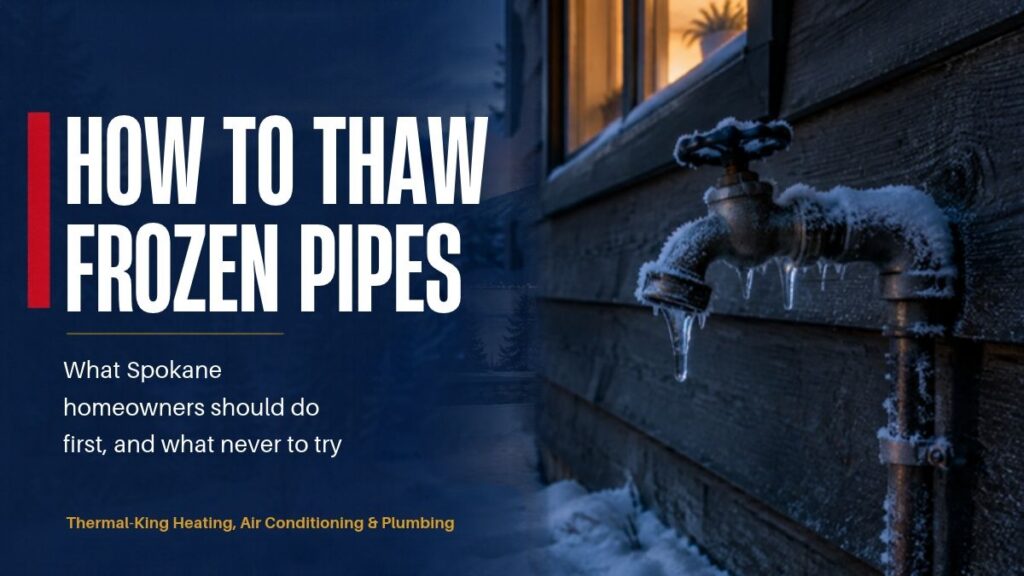
It is 9 degrees at six in the morning, you turn on the kitchen tap, and you get a thin trickle or nothing at all. Before you look up how to thaw frozen pipes and reach for a heat source, do one thing first: find your main water shutoff. The pipe may already be split. Right now the ice is plugging the hole, and the leak starts when the ice lets go.
Table of Contents
Why a Frozen Pipe Bursts Somewhere Else
Most people picture ice swelling until it cracks the pipe at the frozen spot. That is rarely what happens.
Ice forms a plug. As the plug grows, it pushes the water in front of it toward the closed faucet, and that water has nowhere to go. Pressure builds in the trapped section between the ice and the faucet until the pipe or a fitting gives way. The split is often a few feet from the ice, in a stretch of pipe that never froze.
This explains two things. A burst pipe usually stays dry until it thaws, so the damage shows up hours later. And an open faucet protects you, because it gives that trapped water a way out.
How to Thaw Frozen Pipes, Step by Step
1. Work out how much is frozen
Try every faucet in the house. If only one is dead, the freeze is on the line feeding it, usually where the pipe runs through an outside wall, a crawl space, or the garage. If nothing runs anywhere, the freeze is at the main line or the meter. That one is a call to a plumber.
2. Open the faucet
Open both the hot and cold handles on the affected faucet and leave them open. This relieves the pressure, and once water starts to move, the flow helps melt the rest of the ice.
3. Find the frozen section
Follow the pipe back from the faucet. Look for frost on the outside, a slight bulge, or a section that is far colder to the touch than the rest. Under a kitchen sink on a north wall is the usual suspect. If you see a bulge or a crack, shut the main off before you add any heat.
4. Warm it from the faucet end
Use a hair dryer, a heating pad wrapped around the pipe, or towels soaked in hot water. Start at the end nearest the faucet and work back toward the frozen section. The direction matters. Melt the middle of the plug first and you make a pocket of water with ice on both sides of it, which is the same trapped pressure that splits pipes.
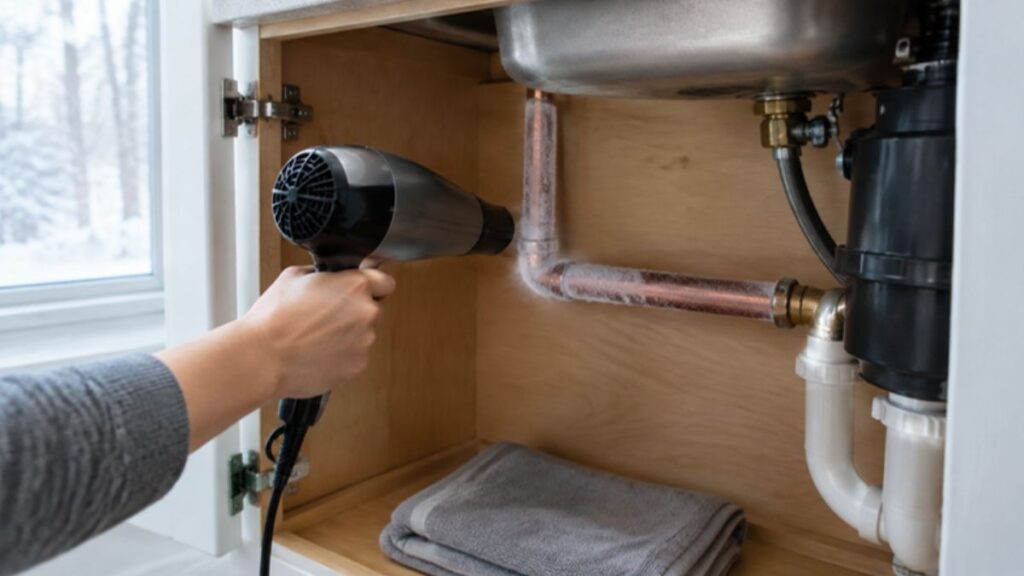
Open the cabinet doors and turn the thermostat up a few degrees while you work. An exposed pipe usually lets go in 30 to 45 minutes.
5. Check for leaks as the water returns
When full pressure comes back, close the faucet and walk the whole line. Look at the ceiling below any upstairs bathroom. A split shows up now.
What We Do Not Recommend
Most bad advice on how to thaw frozen pipes involves a flame. Do not use a propane torch. It is the fastest way to thaw a pipe and the most common way to set fire to the framing behind it. A torch can also boil the water inside the pipe and melt a soldered joint. If the only tool that will reach the pipe is a flame, stop there.
Do not leave a space heater running unattended in a crawl space or against a cabinet. Stay with it, or do not use it.
Do not assume plastic pipe is safe. PEX tubing stretches and survives a freeze better than copper does, but the brass fittings that join it do not stretch at all.
And do not relax because the water is running again. Check the line again the next morning.
When to Stop and Call a Plumber
Knowing how to thaw frozen pipes includes knowing when to stop. Call if the frozen section is inside a wall or ceiling where you cannot reach it, if no faucet in the house works, or if you have had heat on the pipe for an hour with no change. Call right away if you find a split.
If a pipe has already burst, shut off the main, open the faucets to drain what is left in the lines, and keep clear of any water near outlets or the electrical panel. Our plumbers handle emergency pipe repairs across Spokane, Spokane Valley, Coeur d’Alene, Post Falls, and Hayden. If the same line freezes every winter, rerouting it out of the outside wall is a permanent fix, and that falls under our repiping service.
How to Keep Pipes From Freezing Again
Once you know how to thaw frozen pipes, the better project is never needing to. The cold snaps that freeze pipes here arrive when arctic air drains south out of British Columbia and the wind swings to the northeast. A night at 15 degrees with that wind does more damage than a still night at 5, because the draft finds every gap in a foundation vent or a rim joist.
- Take the garden hoses off. A frost-free hose bib only drains if nothing is attached to it. Leave a hose on and the water stays in the barrel, freezes, and splits the pipe inside the wall. You find out in April.
- On the coldest nights, let the at-risk faucet run a stream about the width of a pencil lead. Moving water can still freeze. The drip works because it relieves pressure.
- Open the cabinet doors under sinks on outside walls.
- Insulate pipes in the crawl space and garage, and seal the gaps where they pass through the wall.
- Leaving for the holidays? Keep the thermostat at 55 or higher. Lake cabins around Coeur d’Alene and Hayden that sit empty all winter should be drained and winterized instead.
A dead furnace is the other common cause. If the heat goes out overnight in January, the pipes are next, so our post on a furnace that will not turn on is worth a look before you need it. The American Red Cross also keeps a short frozen pipes checklist.
Not sure where your main shutoff is? Find it this week. Our plumbing team can tag it for you during any visit.
Frequently Asked Questions
How long does it take to thaw frozen pipes?
An exposed pipe usually thaws in 30 to 45 minutes with a hair dryer or heating pad. A pipe inside a wall takes longer and often needs a plumber.
Will frozen pipes thaw on their own?
Eventually, yes. But the pressure stays in the line the whole time you wait, and you will not be watching when it lets go. Thaw it on purpose, with the faucet open.
At what temperature do pipes freeze?
Water freezes at 32 degrees, but pipes inside a house are usually safe until the outside temperature holds at 20 or below for several hours. Wind and drafts lower the margin.
Can I use a heat gun to thaw a frozen pipe?
Only on a low setting, kept moving, and never on plastic pipe or near wood. A hair dryer is slower and much safer. Never use an open flame.
Should I turn off the water if my pipes are frozen?
If you can see a bulge or split, yes, before you add heat. Otherwise leave the main on with the faucet open so you can tell when flow returns, and stay close to the shutoff.