


Heat Pump vs Air Conditioner: What to Know Before You Replace Your AC
Most people do not research heat pumps because they are curious. They research them because their air conditioner died in the middle of July and someone mentioned a heat pump might be worth a look. If that is roughly where you are, the heat pump vs air conditioner decision comes down to something simpler than the brochures suggest: do you want the new equipment to handle only summer, or summer and winter both. Here is the honest comparison, including the cases where we tell homeowners a heat pump is the wrong call.
But how do you get heat out of cold air?
This is the part that sounds like a magic trick, so here is the actual mechanism.
Cold air is not empty of heat. Cold only means there is less of it. Air at 30 degrees still contains a large amount of heat energy. It is just colder than you want your living room to be. There is real heat in the outdoor air, even when it is well below zero, which is why this works at all.
Heat always moves from warmer to cooler. So to pull heat out of 30-degree air, you need something colder than 30 degrees to pull it into. That is exactly what the equipment arranges. The refrigerant entering the outdoor coil is driven far colder than the surrounding air, often well below zero. Next to the refrigerant at 10 below, 30-degree air is warm, and heat flows from the air into the refrigerant, as physics dictates.
The compressor then compresses the refrigerant, raising its temperature sharply. Anyone who has felt a bicycle pump get hot has seen the same effect. Now the refrigerant is hotter than your house, so indoors it gives that heat up to your air, and the loop runs again.
Your refrigerator does the identical thing. It pulls heat from a cold box and releases it into your warm kitchen, which is why the coils behind it are warm. Nobody finds a fridge suspicious. A heat pump in winter is a refrigerator with your house on the warm side.

Heat pump vs air conditioner: the real differences
Cooling: identical
In cooling mode, there is nothing to choose between them. A heat pump and an air conditioner at the same efficiency rating cool your house the same way, for the same money, with the same comfort. Same compressor, same coils, same refrigerant. If someone tells you a heat pump cools worse, they are wrong.
Heating: the whole point
An air conditioner does nothing in January. A heat pump becomes your heating system, and your gas furnace either comes out or drops back to a backup role for the coldest stretches.
Running cost: the actual numbers
Most articles wave their hands here. We will not.
A gas furnace burns fuel to make heat. The best ones turn about 95 percent of the gas into heat in your house, and no furnace can ever beat 100 percent, because you cannot get more heat out of fuel than the fuel contains. A heat pump is not playing that game. It does not make heat, it moves heat that already exists, so it is not capped at 100 percent. A good cold-climate unit delivers roughly two to three units of heat for every unit of electricity it draws, depending on how cold it is outside.
Now put our actual rates against that. At Avista’s current residential rates, running a 95 percent gas furnace and running a well-chosen cold-climate heat pump across a Spokane heating season land within a few percent of each other. Not double. Not half. Roughly level.
Against propane, it is not close. A heat pump costs around half as much to run. Against electric baseboard or wall heaters, less than half. Those are the homes where the switch pays for itself quickly and obviously.
One thing you should hear from us rather than discover on a bill: Avista has a rate case pending that would raise residential electricity faster than natural gas over the next few years. If it goes through as filed, it narrows the heat pump’s case against gas. It does not touch the propane or electric resistance picture, where a heat pump still wins comfortably.
Upfront cost
A heat pump costs more than a new air conditioner, because it does more. But if your AC has failed and your furnace is also near the end, the arithmetic changes, because one heat pump replaces both. That is the scenario where it tends to make sense. If the upfront gap is the sticking point, we can walk through financing options.
The cold weather question
This is the real objection, and it deserves a straight answer rather than a sales one.
The old reputation was earned. Heat pumps from fifteen or twenty years ago genuinely faltered below freezing and fell back on expensive electric strip heat exactly when you needed heat most. Plenty of people here remember that, and they are not wrong about what they lived through.
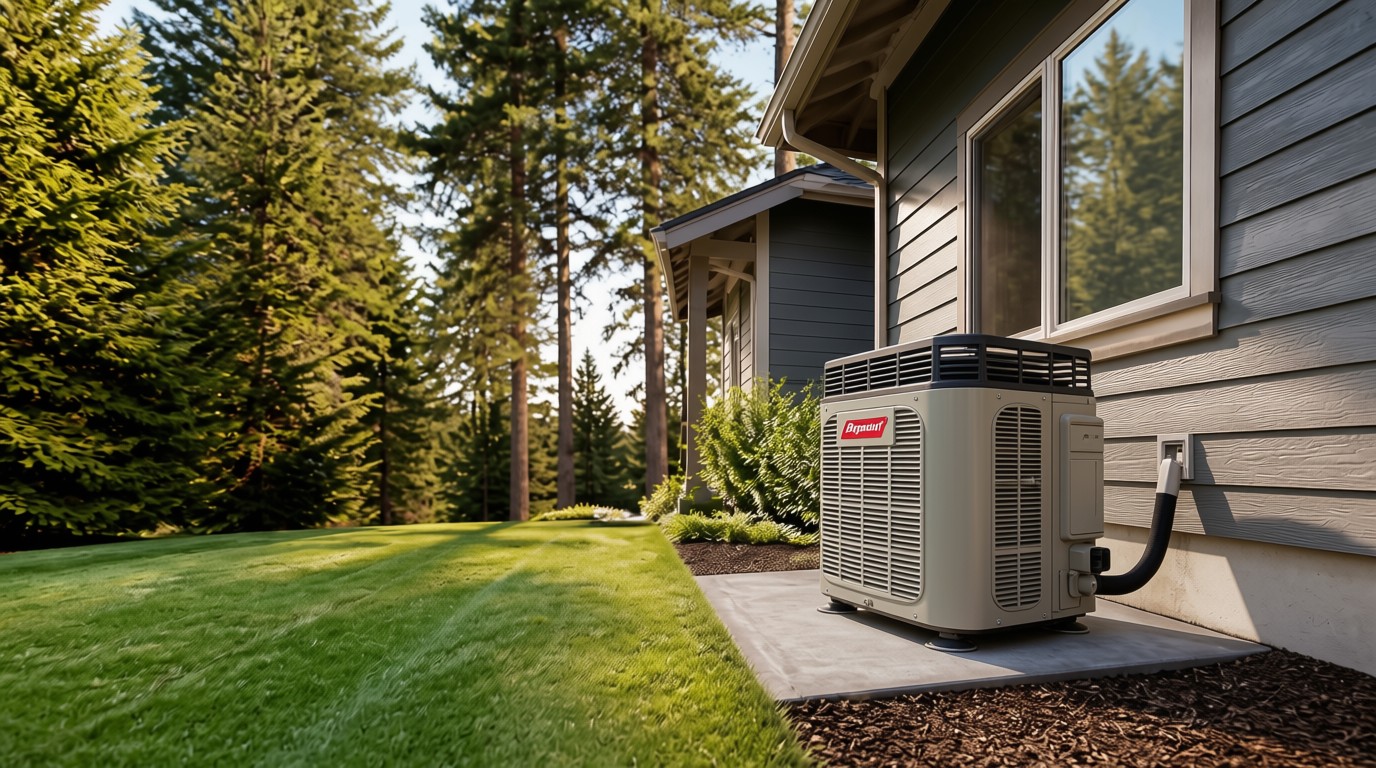
Cold-climate equipment changed the picture. The Bryant equipment we install includes the Evolution Extreme, rated 21.2 SEER2 for cooling and 12.5 HSPF2 for heating, with variable-speed compression built to hold capacity as the temperature drops rather than surrendering at 35 degrees.
Three honest caveats, because this is where people get sold something they regret.
Capacity still falls as it gets colder. Less heat outside means less heat to collect, so the unit works harder for less. A modern one keeps working. It just delivers less. In our climate, a properly designed system usually keeps a backup heat source for the genuinely brutal nights, and that is a feature, not an admission of failure.
It will do things that look like faults but are not. Your heat pump will periodically run a defrost cycle, briefly reversing to melt frost off the outdoor coil. The unit will steam. The indoor air may get cool for a few minutes. That is normal and it is the machine working correctly.
Sizing and installation matter more than the badge. A badly sized heat pump will disappoint you no matter whose name is on it, and no amount of good equipment fixes a bad load calculation. This is not the corner to cut on price.

When a heat pump makes sense
- Your AC has failed and your furnace is also aging. One system replaces two, and that is where the money works.
- You heat with propane or electric resistance now. This is the strongest case there is, and it is not close.
- You want heating and cooling from one system and one maintenance visit.
- You are building or renovating and can size it properly from the start.
- You are interested in a ground-source geothermal system and have the land. Higher upfront, the best efficiency available, and something few contractors in this region actually install.
When it does not
- Your furnace is healthy and only the AC failed. Replacing a working furnace to make the math work rarely pays.
- You are on Avista natural gas and staying there. As the numbers above show, the running cost is close to level, so you are buying flexibility and a smaller carbon footprint, not a lower bill. Some people want that. It should be an informed choice, not a surprise.
- You are selling within a couple of years. The payback window is longer than you will own the house.
We would rather say that now than sell you something you resent later. If a straight AC replacement is the right call for your house, that is what we will quote.
What to do next
If your AC is down right now, the first question is whether it is repairable, because a failed capacitor is a very different conversation from a failed compressor. If it is genuinely at end of life, that is the moment to take this comparison seriously, because you are buying equipment either way.
Our team installs and services heat pumps across Spokane, Spokane Valley, Liberty Lake, Coeur d’Alene, Post Falls, and Rathdrum. We will put both quotes in front of you with the numbers for your actual house rather than a national average. If you go ahead, the heat pump installation is where the sizing work we mentioned above is actually done.
Frequently asked questions
No. No outdoor air enters your home at any point. The only thing that moves between outside and inside is refrigerant, sealed in a copper loop. It collects heat outdoors and releases it indoors, the same way your air conditioner collects heat indoors and releases it outdoors in summer.
Cold air still contains heat. Cold only means less of it. The refrigerant in the outdoor coil is driven colder than the outside air, often well below zero, and heat always flows from warmer to colder. So heat moves from the air into the refrigerant. The compressor then raises that refrigerant’s temperature until it is hotter than your house, and it releases the heat indoors.
It depends on what you burn now. Against Avista natural gas at current rates, a cold-climate heat pump and a 95 percent furnace cost within a few percent of each other over a season. Compared to propane, the heat pump costs roughly half as much. Against electric baseboard, less than half. We will run your actual numbers rather than quote an average.
Almost always a defrost cycle. The unit briefly reverses to melt frost off the outdoor coil, which is why it steams. It lasts a few minutes and it is the system working correctly, not failing.
Often, yes, and that is usually where the cost comparison works best, because one system does the work of two. In our climate most well-designed systems keep a backup heat source for the coldest nights.
That comes from a load calculation on your actual house, not from the size of the old unit. Older systems were frequently oversized, and copying that number forward is one of the most common ways a heat pump can disappoint someone.